
Soon stocks will run out
Dont miss this opportunity while supplies last.


Top 7 Health Benefits of Tapioca Powder
Tapioca powder is a fine white starch made from the cassava root, known as kappa or maravalli kizhangu in Kerala. It turns up in sabudana, snacks, puddings, and gluten-free baking. Online pages often call it a superfood and credit it with heart health and “safe weight gain”. The truth is simpler. Tapioca is almost pure starch, so its real strengths.
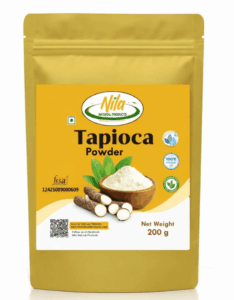
What Is Tapioca Powder?
Tapioca powder is the starch taken out of the cassava root. The root is washed, peeled, grated, and soaked, and the starch is then separated and dried into a soft white powder. It is also sold as tapioca starch or tapioca flour. It is not the same as cassava flour, which is the whole dried root ground up and keeps some fibre. Tapioca has a neutral taste, thickens soups and sauces, binds batters, and gives gluten-free breads a chewy texture. Raw cassava contains natural compounds that can release cyanide, so the root must be processed properly. Tapioca powder from a trusted brand has already been through this step.
What Is in Tapioca Powder?
Tapioca powder is mostly carbohydrate. A 100 g serving gives roughly 350 to 380 calories and about 85 g of carbohydrate, with less than 1 g each of protein, fat, and fibre. It has very few vitamins and minerals. Cassava root does contain some resistant starch, but processing leaves little of it in the powder. So tapioca is a useful ingredient, not a nutrient-rich food.
Top 7 Health Benefits of Tapioca Powder
1. A Gluten-Free, Grain-Free Option
Tapioca powder is naturally free of gluten, grains, and nuts. This makes it a handy choice for people with celiac disease, wheat allergy, or gluten sensitivity. If you have celiac disease, look for a pack marked gluten-free, because a product can pick up gluten from shared machines.
2. May Be Gentle on the Stomach
Plain tapioca is low in fibre, easy to digest, and low in FODMAPs, so some people with a sensitive gut or IBS tolerate it well. This does not mean it treats any digestive problem. Because it has almost no fibre, eating a lot of it can make stools harder, so pair it with vegetables or other fibre-rich foods.
3. Free From Many Common Allergens
It contains no dairy, soy, nuts, or wheat, which makes it a useful base for people with food allergies. Cassava allergy is rare, but it does happen. Stop using it and see a doctor if you get a rash, swelling, or trouble breathing.
4. Fat-Free and Cholesterol-Free
Tapioca has almost no fat and no cholesterol. Using it to thicken a dish instead of butter or cream can lower the saturated fat in that dish. This does not make tapioca “heart-healthy” on its own. It has no fibre and very little else, and heart health depends on your whole diet.
5. A Quick Source of Energy
The starch in tapioca is easy to digest and gives fast energy, which can help active people or someone with a low appetite after an illness. The same quick digestion means it raises blood sugar fast. Its glycaemic index is often put at around 70, which is medium to high. If you have diabetes, keep portions small, pair it with protein and vegetables, and ask your doctor how much suits you.
6. May Help When You Need Extra Calories
Tapioca is dense in calories and easy to stir into porridge or drinks, so it can add calories to the diet. It adds calories, not nutrition, because it has almost no protein. Online pages that call it a safe way to gain weight go too far. If you need to gain weight for medical reasons, work with a doctor or dietitian and combine tapioca with protein-rich foods.
7. A Low-Protein, Low-Sodium Starch for Special Diets
Some kidney diets limit protein and sodium, and tapioca starch is sometimes used as a low-protein starch in these plans. Do this only under the guidance of your doctor or dietitian. Kidney patients often need to watch potassium and phosphorus too, and too little protein can cause deficiency.
Conclusion
Tapioca powder is a simple, gluten-free and allergen-friendly starch that is easy to digest and provides quick energy. It is commonly used in various food preparations and is suitable for people looking for a gluten-free ingredient. Its main benefit is providing carbohydrates for energy. For better health, include tapioca powder along with other nutrient-rich foods as part of a balanced and varied diet.
FAQ’s
1. Is tapioca powder good for you?
It can be a useful part of a balanced diet, especially as a gluten-free, allergen-friendly starch that is easy to digest. It is mostly carbohydrate, with very little protein, fibre, vitamins or minerals, so it should go along with other nutrient-rich foods.
2. Is tapioca powder gluten-free?
Yes, it is naturally free of gluten, grains and nuts. If you have celiac disease, choose a pack marked gluten-free, because a product can pick up gluten from shared machines.
3. Can people with diabetes eat tapioca powder?
Only in small portions. Tapioca raises blood sugar fast, and its glycaemic index is often put at around 70. Pair it with protein and vegetables, and ask your doctor how much suits you.
4. Can tapioca powder help me gain weight?
It adds calories, but it adds almost no protein or other nutrition. Pages that call it a safe way to gain weight go too far. If you need to gain weight for medical reasons, work with a doctor or dietitian.
5. Is tapioca powder safe to eat?
Tapioca powder from a trusted brand has been processed properly and is safe. Raw cassava contains natural compounds that can release cyanide, so the root must always be processed before eating.


